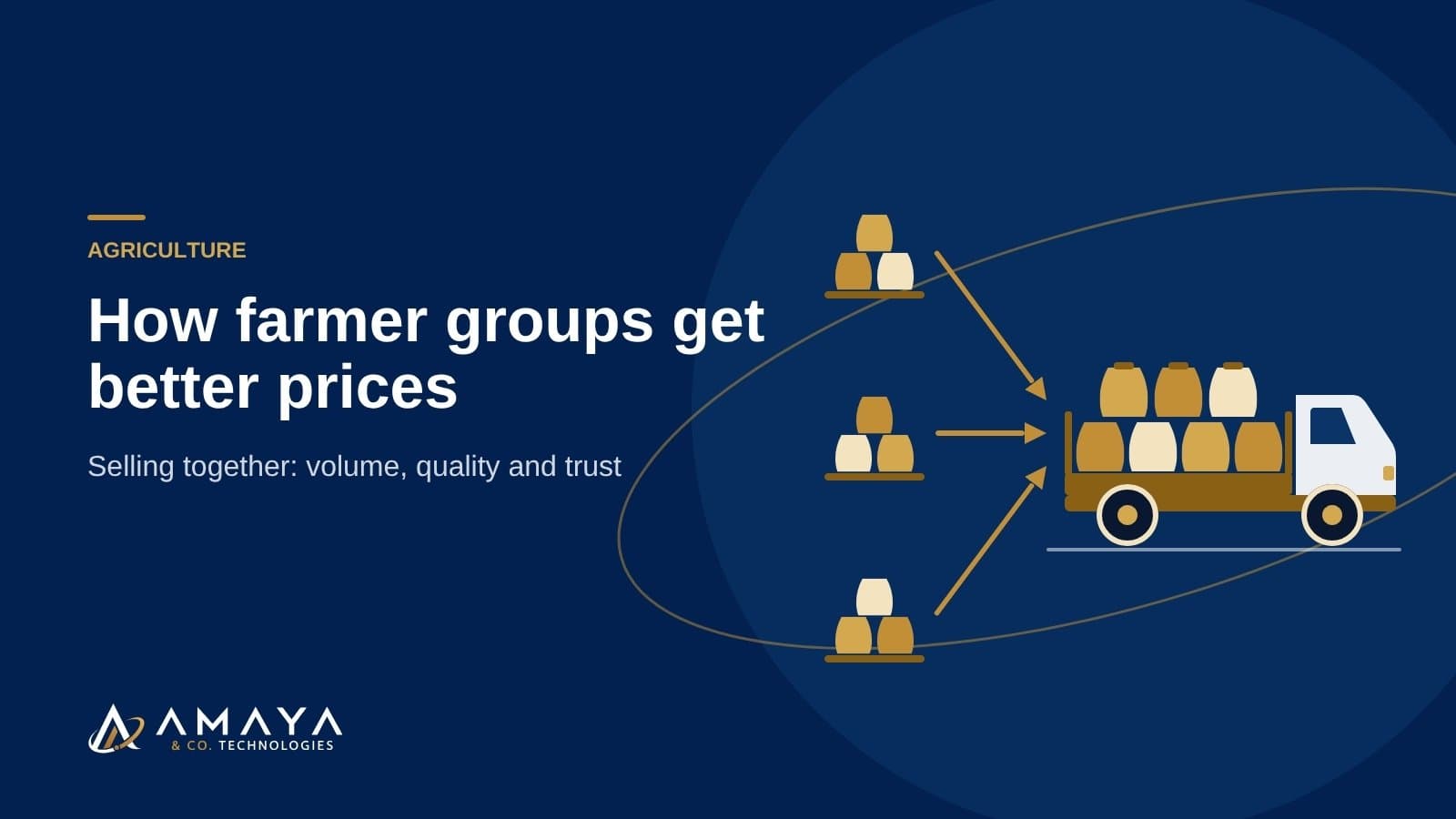
Why selling together pays for farmer groups
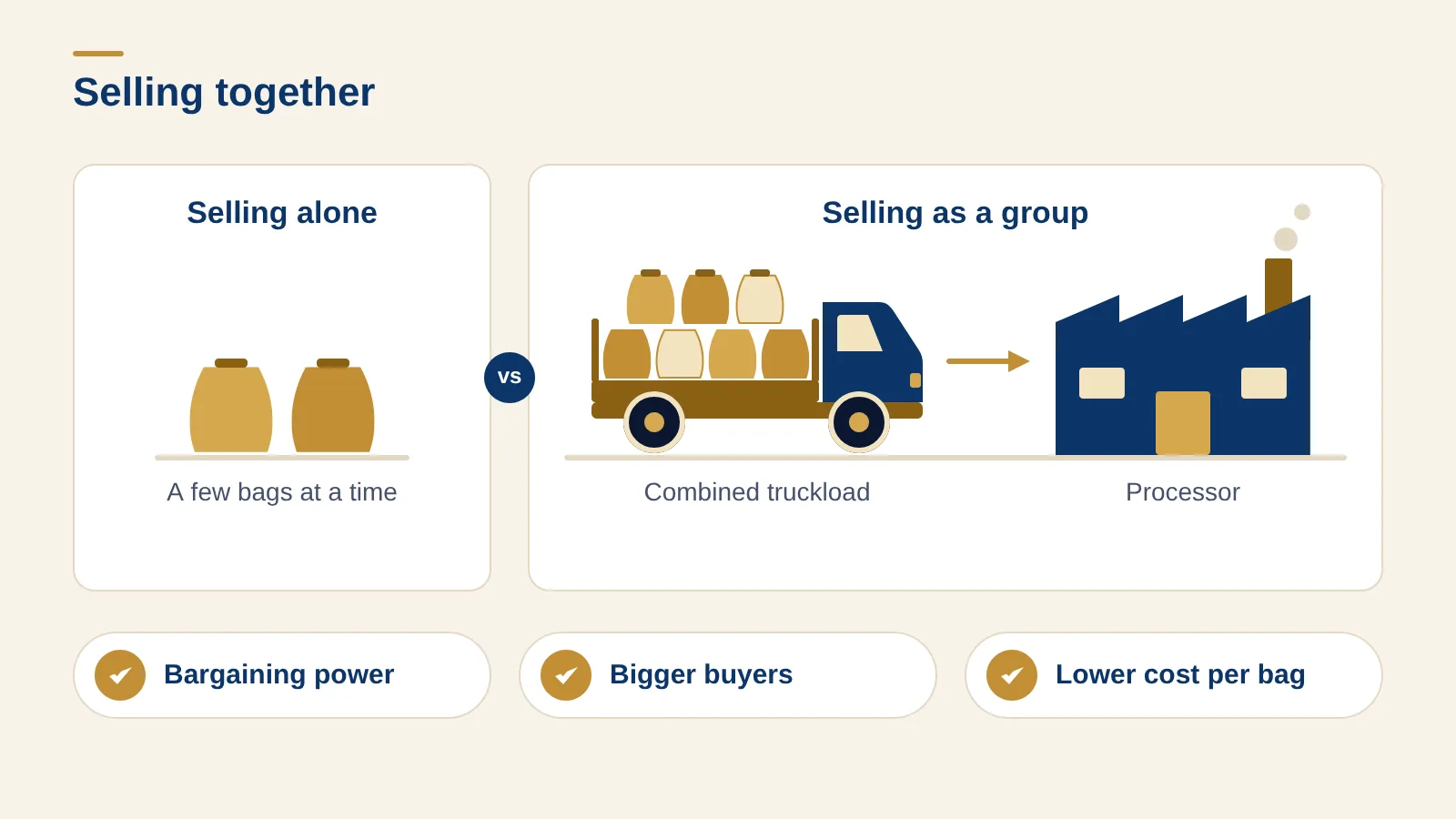
- Bargaining power — a buyer who needs a truckload will negotiate with a group that can supply it.
- Access to bigger buyers — processors, exporters and large off-takers often will not deal with individual smallholders, but will buy from organised groups.
- Lower costs per bag — shared transport, storage and packaging cost less per unit.
- Better timing — with shared storage, the group can wait for prices to recover instead of selling at the harvest low.
- Finance — lenders and input suppliers are often more willing to work with organised groups that keep records.
What buyers expect
Larger buyers want reliability. Before approaching them, the group should be able to offer:
- Consistent volume — a realistic idea of how much the group can supply, and when.
- Consistent quality — produce sorted and graded to an agreed standard: size, moisture, cleanliness, variety.
- Reliable delivery — the right quantity, at the agreed time and place.
- Clear contact and paperwork — one person or committee to deal with, and proper receipts and invoices.
Step by step: organising collective sales
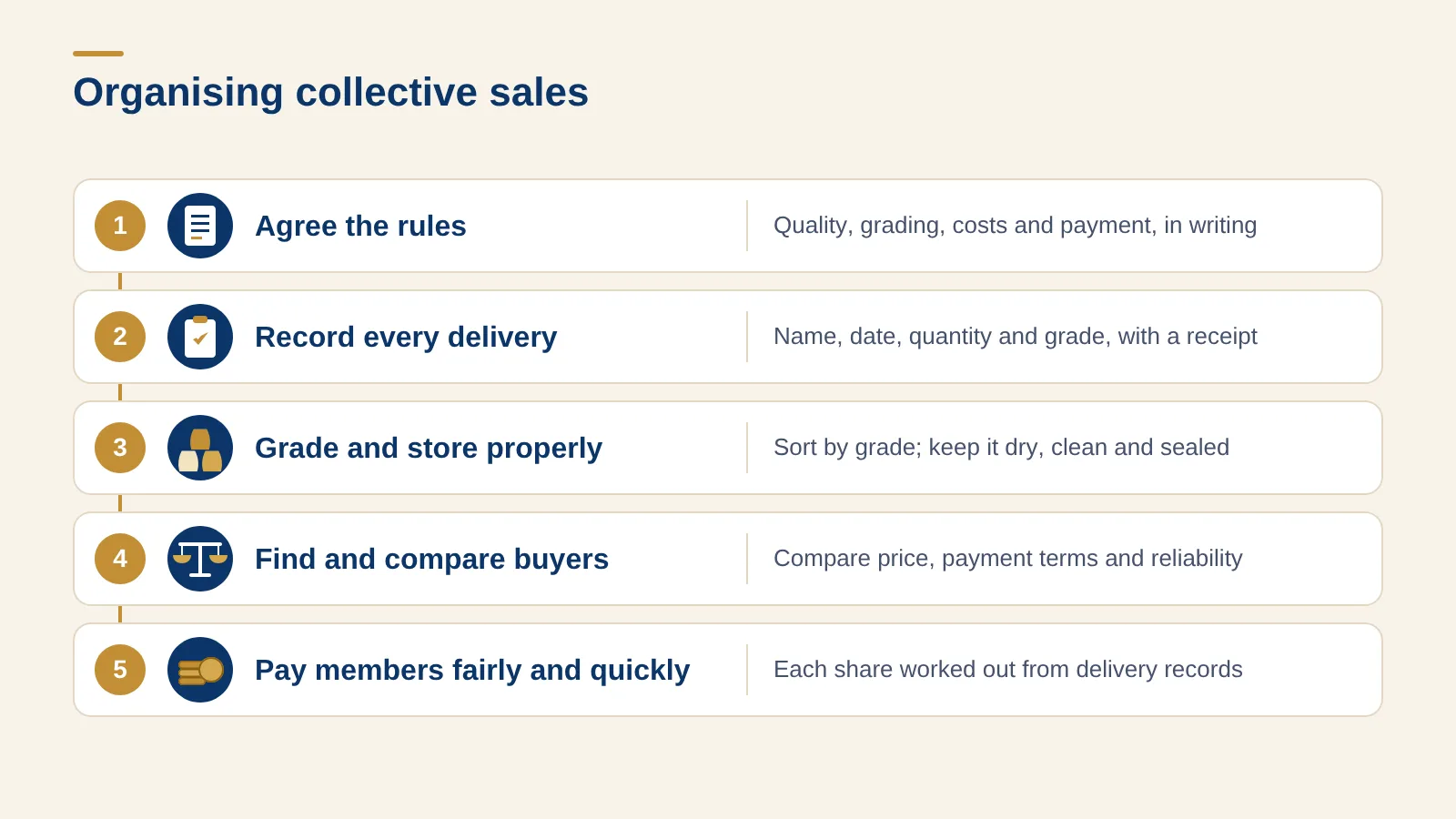
1. Agree the rules
Before the season starts, members should agree in writing:
- What each member will contribute, and the quality standard.
- How produce is weighed, graded and recorded when it is delivered.
- Who negotiates with buyers and who approves deals.
- How costs (transport, storage, bags, levies) are shared.
- How and when members are paid.
2. Record every delivery
When a member delivers produce to the group, record their name, date, quantity, grade and any deductions. Give the member a receipt. These records are the basis for fair payment — and the most common source of disputes when they are missing.
3. Grade and store properly
Sort produce into grades and store it well, so it keeps its value while the group waits for a good price. Good drying and clean, sealed storage protect quality. Our guide to reducing post-harvest losses covers the practical steps.
4. Find and compare buyers
Approach several buyers — processors, aggregators, wholesalers, institutional buyers — and compare offers on price, payment terms and reliability. Where possible, agree prices and terms before harvest, through a contract or a written agreement.
5. Pay members fairly and quickly
Once a buyer pays, calculate each member's share from the delivery records: quantity delivered × agreed price for that grade, minus their share of costs. Pay promptly and show each member how their payment was worked out. Transparency is what keeps members selling through the group next season.
Common problems — and how to avoid them
- Side-selling — members selling to other buyers after the group has made a commitment. Clear agreements, fair prices and fast payment are the best prevention.
- Disputes over weights and grades — record everything at delivery, in front of the member.
- Slow payment — members who wait too long for money stop delivering. Agree payment terms with buyers that let the group pay members quickly.
- Records in one person's notebook — when that person leaves, the history goes too.
Records are the foundation
Every part of collective selling depends on records: member deliveries, grades, stock in storage, sales, costs and payments. Our guide to farm record keeping covers what individual farmers should record; groups need the same discipline across all members.
How Amaya & Co. can help
We work with farmer groups, cooperatives and aggregators to replace manual records with systems that fit how they work:
- Cooperative digitisation — member records, contributions, deliveries and payouts that every member can see.
- Custom software and business automation for aggregators tracking produce from collection to sale.
- Training in record keeping and digital tools for farmer groups and programme beneficiaries.
See how we work with agriculture, or contact us to talk about your group or programme.
For farmer groups, better prices come from volume, quality and trust — and all three depend on good records.