
Markup vs margin: the difference in one example
You buy a carton of noodles for ₦8,000 and sell it for ₦10,000. Your profit on that carton is ₦2,000.
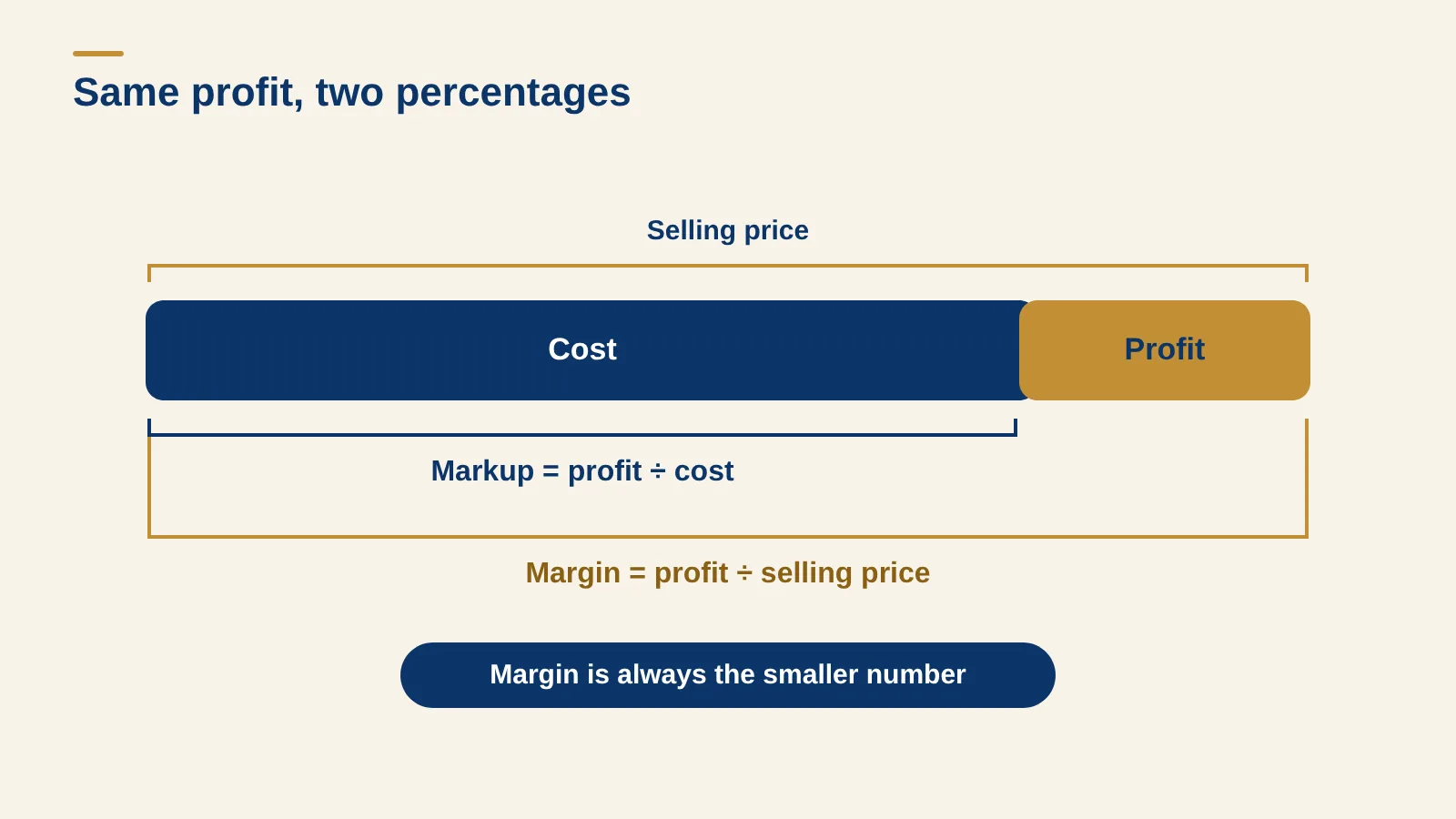
- Markup compares profit with what the item cost you: ₦2,000 ÷ ₦8,000 = 25%.
- Margin compares profit with the selling price: ₦2,000 ÷ ₦10,000 = 20%.
Same carton, same ₦2,000 profit — but a 25% markup is only a 20% margin. Margin is always the smaller number, because the selling price is always bigger than the cost.
Why the difference matters
Suppose you want to keep 25 kobo of every naira you take as profit — a 25% margin. If you simply add 25% to the cost, you only get a 20% margin. Over a year of sales, that 5-point gap can be the difference between growing and standing still.
Margin is also the number that matters when you look at your whole business. Your sales total is made of selling prices, so expenses and profit are naturally compared with sales — which is margin, not markup.
The formulas, in plain language
Markup % = (selling price − cost) ÷ cost × 100
Margin % = (selling price − cost) ÷ selling price × 100
To hit a target margin, work out the price like this:
Selling price = cost ÷ (1 − target margin)
Example: an item costs ₦7,000 and you want a 30% margin. ₦7,000 ÷ (1 − 0.30) = ₦7,000 ÷ 0.70 = ₦10,000. Check it: ₦3,000 profit ÷ ₦10,000 price = 30%.
Quick conversion table
| If you add this markup… | …your margin is |
|---|---|
| 10% | 9.1% |
| 20% | 16.7% |
| 25% | 20% |
| 33.3% | 25% |
| 50% | 33.3% |
| 100% | 50% |
Step by step: setting a price that covers everything
1. Use your full cost, not just the supplier price
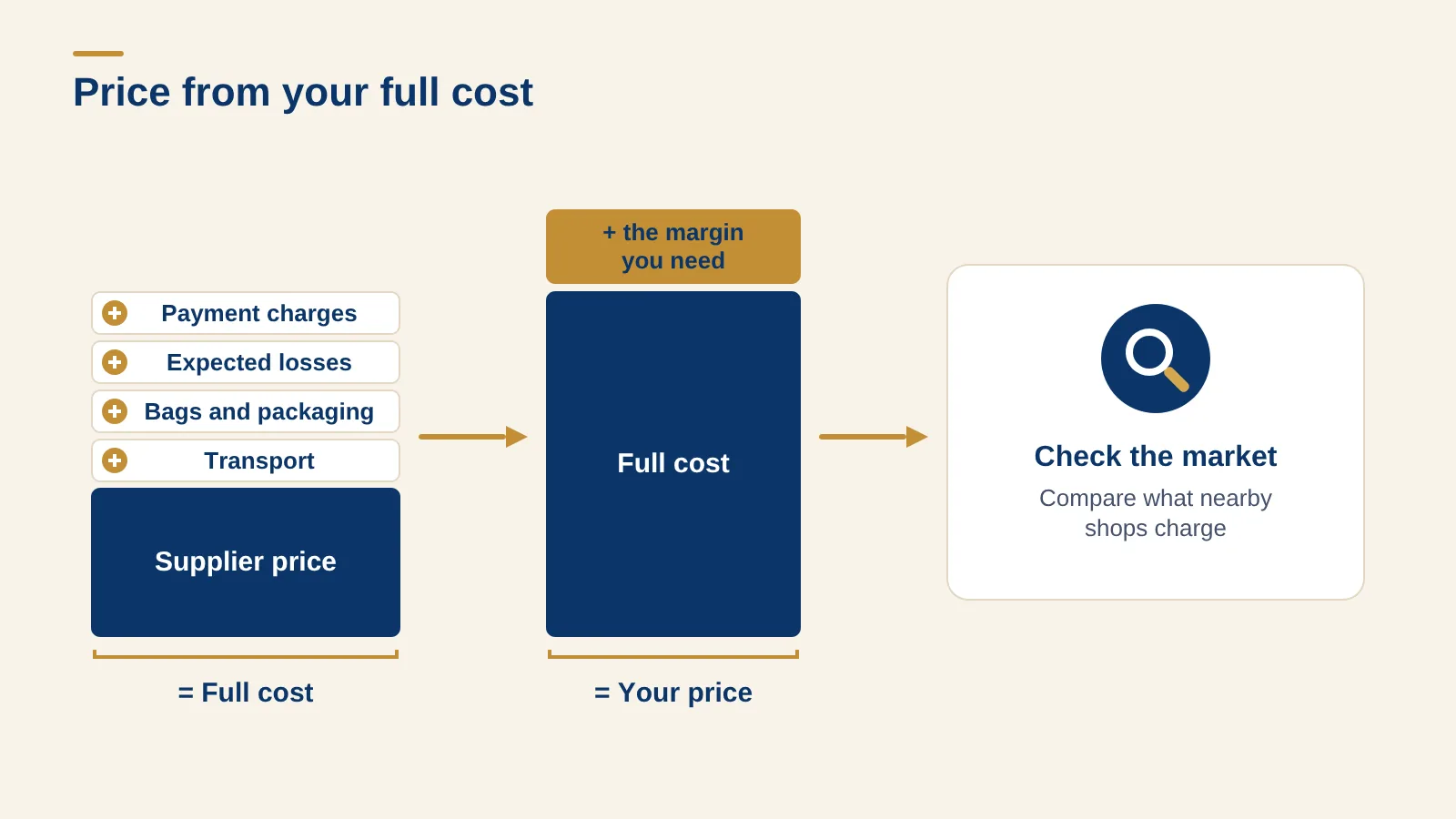
Your real cost per item includes more than what you paid the supplier. Add your share of:
- Transport to bring the goods to your shop.
- Loading, packaging or bags.
- Expected losses — breakage, spoilage or expiry on that kind of item.
- Payment charges, if most customers pay by POS or transfer.
If a ₦8,000 carton costs ₦300 to transport and ₦100 in bags and charges, your real cost is ₦8,400.
2. Know the margin you need
Your margins across all products have to pay for rent, staff, levies, data, electricity — and still leave profit. Our guide to calculating your real business profit shows how to add these up. If your monthly running costs are a large share of sales, you need a higher average margin to stay ahead.
3. Check the market
Price is not only arithmetic. Look at what nearby shops and competitors charge. If the price your formula gives is far above the market, you may need to buy cheaper, sell more of that item, or accept a lower margin on it and earn more on others.
4. Price products differently
Not everything needs the same margin:
- Fast-moving basics that customers compare (rice, sugar, noodles) often carry low margins but sell in volume.
- Convenience and slower-moving items can usually carry higher margins.
- Items with a risk of spoilage need extra margin to cover losses.
5. Review prices regularly
When supplier prices rise, update your selling prices quickly. In a fast-changing market, selling yesterday's stock at yesterday's price can mean you cannot afford to restock today.
Common pricing mistakes
- Pricing from memory instead of from the latest cost.
- Forgetting transport and charges, so the real margin is lower than planned.
- Giving discounts without checking the margin — a 10% discount on a 20% margin item removes half your profit on it.
- Never reviewing prices after costs go up.
How KudiAI Track helps
KudiAI Track keeps each product's cost price and selling price, so you can see the margin on every item, the stock value of your shop, and how sales and profit add up over the week and the month. Its inventory view shows what is selling and what is not moving, which helps you decide where to adjust prices.
Book a short demo to see it with examples from your kind of business, or read our guide to inventory management for small businesses.
Once you understand markup vs margin, pricing stops being guesswork: start from your full cost, choose the margin you need, then check it against the market.